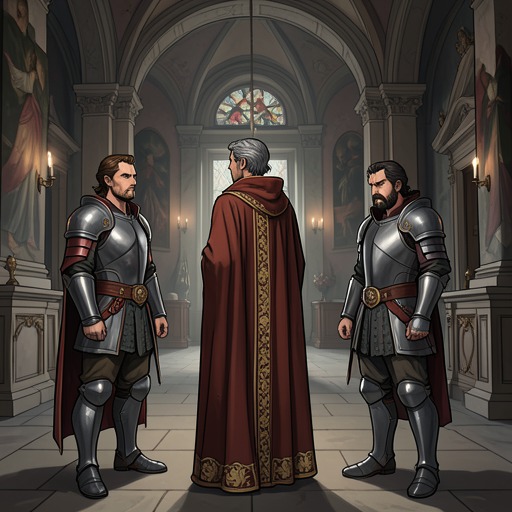
Unauwen's Principle of Royal Succession and an Indivisible Realm
De brief voor de KoningUnauwen's Principle of Royal Succession and an Indivisible Realm is the political rule King Unauwen defends against both a challenge to his chosen heir and the partition of his kingdom. Its force is tested when the king’s younger son rejects the succession, takes Eviellan, and claims authority equal to his father’s. The ensuing conflict shows the distinction between a realm’s declared unity and the unrest that can persist after its ruler has defended that unity by force.
Succession and the King’s Principle
The succession follows birth order: the elder of King Unauwen’s two sons is Crown Prince of Unauwen and, from the age of eighteen, serves as viceroy and stadtholder of the realm. The brothers were born on the same day, only minutes apart. They were also alike in appearance and intelligence, circumstances that made the younger prince regard the narrow difference in their ages—and the very different political positions attached to it—as especially difficult to accept. Their resemblance did not extend to their characters. The Crown Prince resembled his father in his concern for the realm and its future subjects; his brother was ambitious and eager for power.
King Unauwen tried repeatedly to reconcile his sons and persuade the younger to accept his place. On the central question of sovereignty, however, he would not yield: he would never divide the realm, which had to remain whole under the rule of the person designated to govern it. The principle therefore joins two claims: that the succession belongs to the appointed heir, and that the kingdom itself is not to be split between rival claimants. The account presents this as the king’s firm political commitment, rather than describing a separate written law or a formal procedure for enforcing it.
From Appointment to Rebellion
In an effort to give his younger son a position within the kingdom, King Unauwen eventually appointed him stadtholder of the southern Province of the Riverlands. The arrangement initially appeared to work. Over time, however, the prince governed with increasing independence and sometimes acted directly against his father’s wishes. The appointment thus gave him authority within the realm without settling the underlying conflict over rank and power.
The break came when the younger prince marched south into Eviellan, conquered the land, and made it a province of Unauwen. King Unauwen revoked that decision and ordered him to withdraw. Instead of obeying, the prince declared himself King of Eviellan and claimed to be his father’s equal, no longer bound to obey him. His declaration challenged both the king’s authority and the integrity of the realm: a territory brought under the kingdom by conquest was recast as the base of a rival sovereignty.
King Unauwen was deeply distressed and removed his son from the stadtholdership. The prince refused to accept his dismissal. His defiance had support among many people in the Province of the Riverlands, so the dispute could not be resolved by the king’s decision alone. The Crown Prince came with an army to take over the office, and the brothers’ followers fought. The eldest prevailed on behalf of Unauwen, restoring the king’s authority over the contested governorship. The military result upheld the succession, but it did not erase the division that had produced the conflict.
The Cost of Preserving Unity
The account marks the victory as a turning point rather than a complete restoration of peace. Something had disappeared from the kingdom: peace and friendship no longer prevailed everywhere. The younger prince, now the Lord of Eviellan, sent bands of warriors into his father’s country to stir up unrest. Although there was no declared war, fighting continued along the border and in the south. Unauwen remained formally undivided, yet the rival claim endured through incursions and continuing disorder.
The principle’s significance lies in that unresolved aftermath. King Unauwen’s refusal to partition the realm prevents the younger prince’s conquest from becoming an accepted division of sovereignty; the Crown Prince’s victory likewise confirms who is to exercise the king’s authority. But neither the king’s insistence nor the army’s success restores the earlier condition of peace. The story presents unity as a governing rule with real consequences, while making clear that enforcing it does not by itself reconcile rival heirs or end resistance.